May 8th Thursday 5pm.
I'm so tired of these semester-end busyyyness.
Showing posts with label class information. Show all posts
Showing posts with label class information. Show all posts
Monday, April 28, 2008

Tuesday, April 15, 2008
Flower Arrangement powerpoint
Someone let me know that the folower arrangement powerpoint on this blog is missing someinformation such as names of schools, names of styles, etc.
I fixed it today, so, if you studied before today, please check the powerpoint again.
Also, I emailed to everybody with the powerpoint as an attached file.
I'm sorry for the confusion.
I fixed it today, so, if you studied before today, please check the powerpoint again.
Also, I emailed to everybody with the powerpoint as an attached file.
I'm sorry for the confusion.
Thursday, April 10, 2008
Hisoty (Showa-Heisei Period) & Ikebana (Flower Arrangement)
*For the next week test, please study with this post and the video transcript which was sent from Shoji on April 10th.
-------------------------------------------
History
昭和時代 1926-1989 Showa Period
The Period of the Pre-War Fascism and Postwar Economic Power
Showa Emperor Hirohito

<before 1945>
1931満州国建設→国際連盟脱退
Japan established a puppet state, Manchukuo in Manchuria <- criticized in the League of Nations -> Japan withdrew the League
1932 5.15 incident海軍将校が犬養毅首相を射殺
Young Marines assassinated Prime Minister
1936 2.26 incident皇道派の青年が大臣を射殺
Young armies assassinated some government officials
<- Power of Military in the government
→軍部大臣現役武官制の復活 =政党政治の終焉
*治安維持法、特高警察による思想弾圧
1937 Second Sino-Japanese War日中戦争開始
1939 WWII began in Europe
1940日独伊三国同盟
Axis Pact: Japan, Germany, Italy
*the US: stop exporting oils to Japan, warn Japan to withdraw from China
1941太平洋戦争開始(真珠湾攻撃)
Pearl Harbor = beginning of “Pacific War”
*Japanese news always report “Japan won!” at any battles
1943大東亜戦争を宣言(石油確保のため、東南アジアを侵略中)
(Japan wanted oils in the Southeast Asia)
Japan Declared “The Great East-Asian War”: save Asians from imperial westerners
1945年
7月26日ポツダム宣言
July 26: Potsdam Declaration (US, UK, China): demand Japan’s surrender
8月6日原爆(広島)
August 6: atomic bomb on Hiroshima
8月8日ソ連参戦→満州国進入→日本人が帰国(*中国残留孤児)
August 8: Russia started war on Japan
-Occupied Japan’s puppet state, Manchukuo
-Took the northern territory of Hokkaido (kept warring until September 4th)
8月9日原爆(長崎)
August 9: atomic bomb on Nagasaki
8月15日ポツダム宣言受諾
August 15: Japan Surrendered
<after 1945>
1945-1951GHQ (General Headquaters of the Allies) occupied Japan. 連合国最高司令官総司令部(多くはアメリカ人)占領
Douglas MacArthurダグラスマッカーサー(→朝鮮戦争で原爆の使用を主張し、解任される)
Douglas MacArthur & Showa Emperor Hirohito

-Emperor lost all political power (God human being)
-New constitution (no military power, women’s voting rights, etc.)
日本国憲法(非武装)
--->
1949 Communist China US sees Japan as a strategic keystone in the Pacific
1951 Korean War US established Japan’s Security Force
->
1951サンフランシスコ講和条約=独立
Japan’s Independence: Treaty of San Francisco

*Okinawa Problem
-Okinawa used to be an independent kingdom –Annexed by Japan in 1872
-The fierce battlefield at the end of WWII (1/4 of Okinawan people died.) –Japan didn’t help Okinawa because Japan wanted to buy time by holding American forces in Okinawa in order to plan the defense of the mainland and get a better deal.
-Had been occupied at 1945-1972 as “residual colony” (Japanese mainland was occupied at 1945-1951.) –Japan’s independence was achieved partly because Japan accepted the US right to use Okinawa as an important station for US pacific military strategy
-Discriminately attitude from both Japanese mainland and the American occupation force
-In 1972, returned to Japan (Prime Minister Eisaku Sato and US President Richard Nixon)
-Today 75% of US bases in Japan are in Okinawa, and 20-25% of Okinawan lands are US bases.
Prime Minister Sato, Eisaku & President Ricahrd Nixon

<経済 Economic growth >
1951-53 special procurements from Korean War 朝鮮特需
1960s special procurements from Vietnam War ベトナム特需
Little burden from the Military budget 防衛費負担なし(⇔思いやり予算負担、米軍とのトラブル)*instead, Omoiyari Budget (“budget allocation for sympathy”): Japan pays a lot for US stationing in Japan.
-“Income doubling program” in the 1960s (by Prime Minister Hayato Ikeda)
Prime Minister Ikeda, Hayato

-“Three sacred treasures” in the 1960s = TV, refrigerator, and washing machine
-“Remodeling the Japanese Archipelago” in the 1970s (by Prime Minister Kakuei Tanaka)
Prime Minister Tanaka, kakuei & President Richard Nixon

*side effect of the economic growth: Pollution and depopulation of the countryside
1989Peak of Japanese economy
“Japan as No. 1”(Book)
平成時代1989-Present Heisei Period
Current Period
1991-1992 “Japan’s Great Depression”バブル崩壊:不動産、株式価格暴落
1990s:”The Lost Decade”「失われた10年」
*→2003くらいから回復基調 slightly getting better
1995 Great Hanshin-Awaji Earthquake 阪神淡路大震災 (in Kinki region)
1995 Sarin gas attack on the Tokyo subway 地下鉄サリン事件 by a cult religion group
1998 Nagano Winter Olympic長野オリンピック
2002 Korea-Japan World Cup Soccer サッカーワールドカップ初出場
----------------------------------------------------
Ikebana (Flower Arrangement) Powerpoint
*At the end of this powerpoint, you see how to make a Ikebana. If you want to make your own one for a extra point, please refer to this page.
http://show.zoho.com/public/sshoji/Ikebana-(flower-arrangement)--Presen-ppt
-------------------------------------------
History
昭和時代 1926-1989 Showa Period
The Period of the Pre-War Fascism and Postwar Economic Power
Showa Emperor Hirohito

<before 1945>
1931満州国建設→国際連盟脱退
Japan established a puppet state, Manchukuo in Manchuria <- criticized in the League of Nations -> Japan withdrew the League
1932 5.15 incident海軍将校が犬養毅首相を射殺
Young Marines assassinated Prime Minister
1936 2.26 incident皇道派の青年が大臣を射殺
Young armies assassinated some government officials
<- Power of Military in the government
→軍部大臣現役武官制の復活 =政党政治の終焉
*治安維持法、特高警察による思想弾圧
1937 Second Sino-Japanese War日中戦争開始
1939 WWII began in Europe
1940日独伊三国同盟
Axis Pact: Japan, Germany, Italy
*the US: stop exporting oils to Japan, warn Japan to withdraw from China
1941太平洋戦争開始(真珠湾攻撃)
Pearl Harbor = beginning of “Pacific War”
*Japanese news always report “Japan won!” at any battles
1943大東亜戦争を宣言(石油確保のため、東南アジアを侵略中)
(Japan wanted oils in the Southeast Asia)
Japan Declared “The Great East-Asian War”: save Asians from imperial westerners
1945年
7月26日ポツダム宣言
July 26: Potsdam Declaration (US, UK, China): demand Japan’s surrender
8月6日原爆(広島)
August 6: atomic bomb on Hiroshima
8月8日ソ連参戦→満州国進入→日本人が帰国(*中国残留孤児)
August 8: Russia started war on Japan
-Occupied Japan’s puppet state, Manchukuo
-Took the northern territory of Hokkaido (kept warring until September 4th)
8月9日原爆(長崎)
August 9: atomic bomb on Nagasaki
8月15日ポツダム宣言受諾
August 15: Japan Surrendered
<after 1945>
1945-1951GHQ (General Headquaters of the Allies) occupied Japan. 連合国最高司令官総司令部(多くはアメリカ人)占領
Douglas MacArthurダグラスマッカーサー(→朝鮮戦争で原爆の使用を主張し、解任される)
Douglas MacArthur & Showa Emperor Hirohito

-Emperor lost all political power (God human being)
-New constitution (no military power, women’s voting rights, etc.)
日本国憲法(非武装)
--->
1949 Communist China US sees Japan as a strategic keystone in the Pacific
1951 Korean War US established Japan’s Security Force
->
1951サンフランシスコ講和条約=独立
Japan’s Independence: Treaty of San Francisco

*Okinawa Problem
-Okinawa used to be an independent kingdom –Annexed by Japan in 1872
-The fierce battlefield at the end of WWII (1/4 of Okinawan people died.) –Japan didn’t help Okinawa because Japan wanted to buy time by holding American forces in Okinawa in order to plan the defense of the mainland and get a better deal.
-Had been occupied at 1945-1972 as “residual colony” (Japanese mainland was occupied at 1945-1951.) –Japan’s independence was achieved partly because Japan accepted the US right to use Okinawa as an important station for US pacific military strategy
-Discriminately attitude from both Japanese mainland and the American occupation force
-In 1972, returned to Japan (Prime Minister Eisaku Sato and US President Richard Nixon)
-Today 75% of US bases in Japan are in Okinawa, and 20-25% of Okinawan lands are US bases.
Prime Minister Sato, Eisaku & President Ricahrd Nixon

<経済 Economic growth >
1951-53 special procurements from Korean War 朝鮮特需
1960s special procurements from Vietnam War ベトナム特需
Little burden from the Military budget 防衛費負担なし(⇔思いやり予算負担、米軍とのトラブル)*instead, Omoiyari Budget (“budget allocation for sympathy”): Japan pays a lot for US stationing in Japan.
-“Income doubling program” in the 1960s (by Prime Minister Hayato Ikeda)
Prime Minister Ikeda, Hayato

-“Three sacred treasures” in the 1960s = TV, refrigerator, and washing machine
-“Remodeling the Japanese Archipelago” in the 1970s (by Prime Minister Kakuei Tanaka)
Prime Minister Tanaka, kakuei & President Richard Nixon

*side effect of the economic growth: Pollution and depopulation of the countryside
1989Peak of Japanese economy
“Japan as No. 1”(Book)
平成時代1989-Present Heisei Period
Current Period
1991-1992 “Japan’s Great Depression”バブル崩壊:不動産、株式価格暴落
1990s:”The Lost Decade”「失われた10年」
*→2003くらいから回復基調 slightly getting better
1995 Great Hanshin-Awaji Earthquake 阪神淡路大震災 (in Kinki region)
1995 Sarin gas attack on the Tokyo subway 地下鉄サリン事件 by a cult religion group
1998 Nagano Winter Olympic長野オリンピック
2002 Korea-Japan World Cup Soccer サッカーワールドカップ初出場
----------------------------------------------------
Ikebana (Flower Arrangement) Powerpoint
*At the end of this powerpoint, you see how to make a Ikebana. If you want to make your own one for a extra point, please refer to this page.
http://show.zoho.com/public/sshoji/Ikebana-(flower-arrangement)--Presen-ppt
Monday, March 31, 2008
Comparative Paper 2
I forgot to remind you that the due of the second comparative paper is due this week.
So, I extend the due to the following Thursday (April 10th).
You can submit the paper anytime by April 10th.
Submit by email is fine, but I don't take responsibility for delivery failure from network trouble.
If you haven't written the paper yet, please try to make a comparison with your own analysis, like what you think about the difference, what you feel about it, what you agree or disagree on something in both culture, etc.
I require you to use at least two resources. You can use the sources to get information/facts, but I still want you to write your thought about it. I don't grade your thought. (*like I don't grade your paper bad just because your thought is different from mine. Because I think coexistence of different thoughts is mandatory for coexistence of different culture.) But I just want you to have your thought about it.
In order to understand the different culture, you would process acceptance, resistance, reinterpreting, and so forth. Here is a model of the process of cultural understanding.

This diagram shows three destinations (shown in purple):
1. refusal/ignorance
2. disorganization
3. new balance (understanding)
I hope you don't get to refusal/ignorance in understanding Japan.
Anyway, this is such a late notice. I am soooo sorry.
So, I extend the due to the following Thursday (April 10th).
You can submit the paper anytime by April 10th.
Submit by email is fine, but I don't take responsibility for delivery failure from network trouble.
If you haven't written the paper yet, please try to make a comparison with your own analysis, like what you think about the difference, what you feel about it, what you agree or disagree on something in both culture, etc.
I require you to use at least two resources. You can use the sources to get information/facts, but I still want you to write your thought about it. I don't grade your thought. (*like I don't grade your paper bad just because your thought is different from mine. Because I think coexistence of different thoughts is mandatory for coexistence of different culture.) But I just want you to have your thought about it.
In order to understand the different culture, you would process acceptance, resistance, reinterpreting, and so forth. Here is a model of the process of cultural understanding.

This diagram shows three destinations (shown in purple):
1. refusal/ignorance
2. disorganization
3. new balance (understanding)
I hope you don't get to refusal/ignorance in understanding Japan.
Anyway, this is such a late notice. I am soooo sorry.
Information for 4/10 Test (history and education)
安土桃山時代 1568-1603 Azuchi-Momoyama Period
The Period of Wars
*”Azhichi” and “Momoyama” are the names of castles.
*Also called “Sengoku Period (Warring Period)”
Three Heroes (all three are from Chubu region, around Nagoya):
1. Oda, Nobunaga “Kill the cuckoo if it doesn’t sing”

2. Toyotomi, Hideyoshi “Make the cuckoo sing if it doesn’t sing”

3. Tokugawa, Ieyasu “Wait till the cuckoo sing if it doesn’t sing”

1. 織田信長 Oda, Nobunaga
-Strange acts in the youth
-Grew as a strong warrior
The Battle of Okehazama: 4000 Oda warriors beat over 25000
The Battle of Ngashino (against Takeda Shingen’s son): Use of firearms (introduced in this era by two Portuguese)
-Fierce personality (nicknamed “Devil”)
Unsparing treatment of his subordinates
→本能寺の変 Incident at Honno-ji Temple
Akechi, Mitsuhide killed Nobunaga
(→Hideyoshi killed Mitsuhide soon)
2. 豊臣秀吉 Toyotomi, Hideyoshi
-Parents are peasants
-Served Nobunaga
-Nickname is “Monkey” (*from his looking)
-Rise at the Early Age as a good Strategist
*Right after the Incident of Honno-ji Temple, return from Takamatsu Castle in a week to attack Akechi, Mitsuhide
-Policies
1. Kenchi (Land Survey)
2. Katana-gari (Sword Hunt)
3. Heinou Bunri (Separation of the military from the farming class)
-Decline at the Later Age (nicknamed “Devil”)
1. Persecution of Christianity
2. Invasion on Korea (1552-1553, 1557-1558)
3. More then ten wives, but no strong son
<茶道(tea ceremony: Sado “Way of Tea”)>
Sen no Rikyu

-Sado (Tea ceremony) teacher of Nobunaga and Hideyoshi
-The biggest figure of Sado (tea ceremony) world
-Eventually killed by Hideyoshi
3. 徳川家康 Tokugawa, Ieyasu
-Born at a weak clan
-Served Hideyoshi and got Kanto region lands
-After Hideyoshi’s death
1600 Battle of Sekigahara: Hideyoshi’s followers VS Ieyasu
→Ieyasu won = transfer of the power from Toyotomi family to Tokugawa family
→1603 Open Edo Shogunate = Beginning of Edo Period (lasts until 1868)
*Ieyasu killed Hideyori (Hideyoshi’s son) and destroyed Toyotomi clan
<Video Game: good tool to study Azuchi-Momoyama History>
Sengoku Musou
Samurai Warriors 2
====================================
江戸時代 1603-1868 Edo Period
The Period of Stability,
The End of Samurais’ Rule
-Edo (today’s Tokyo) as the capital city
1st Tokugawa Shogun Tokugawa, Ieyasu
-Local rule by military lords (Daimyo domain) under strong shogunal authority
1. 参勤交代 Sankin Kotai (Alternate Attendance Requirement):
-Daimyo (local lord) come to Edo to see shogun periodically
-Daimyo’s wife and heir had to stay in Edo as hostages
2. 鎖国 National Seclusion:
-traded with only Dutch and China at Dejima, Nagasaki (Kyushu Region)
3. 士農工商 Samurai-Farmers-Artisans-Merchants social class
*“Don’t let farmers alive, don’t let them die”
4. キリシタン禁教 Eradication of Christianity
*Shimabara Uprising by Shiro Amakusa 天草四郎(17 years old歳)

1853 Commodore マシューペリー Matthew Perry forced to open Japan

15th Tokugawa Shogun Tokugawa, Yoshinobu


-->
Rise of xenophobia since the opening of Japan
薩長連合Satsuma-Choshu Alliance fights against Tokugawa Shogunate
*Satsuma clan from Kyushu region and Choshu clan from Chugoku region
1867大政奉還: 15th Shogun Tokugawa, Yoshinobu gives the emperor back the rule of Japan = Satsuma and Choshu clans makes new Meiji government (Meiji Restoration)
*Go-between: 坂本竜馬Sakamoto, Ryoma convinced Tokugawa family to return the power to emperor.

1868-1869 Boshin Wars
Series of the wars between new government and the Tokugawa shogunate supporters
====================================
明治時代 1868-1912 Meiji Period
The Period of Modernization/Westernization
“Edo江戸”→”東京Tokyo”
Meiji Emperor: Mutsuhito moved to Tokyo (from Kyoto)

-Era name元号 started: changes every time when emperor dies
Three biggest leaders of the Meiji Restoration:
1. Kido, Takayoshi (or Katsura, Kogoro): from Choshu Clan

2. Saigo, Takamori: from Satsuma clan

3. Okubo, Toshimichi: from Satsuma clan

New Meiji government
-Abolished clan-system, started prefecture-system
-Equalization of the four divisions of the social class (Samurai-Farmers-Artisans-Merchants) *two social classes still existed (Noblemen –Commoner)
-Founded school system
-Revision of Taxation system (rice money)
-Abolished the Samurai’s privileges (having a sword, unconditional salary)
-->1877 Seinan War (Satsuma Rebellion)
War between Saigo-leading-Satsuma Samurai vs. Okubo-leading Meiji government
Saigo died at the war (*The Last Samurai movie)
*During the war, Kido died from a disease
*Following year, Okubo was assassinated by an anti-government Samurai
*Seinan War was the last military rebellion by Samurai against the Meiji Government
-->
Freedom and People's Rights Movement:
Demand the parliament system with the election/voting.
-Okuma, Shigenobu: founded Constitutional Reform Party

-Itagaki, Taisuke: founded Liberal Party

--->First Parliament
1885 1st Prime Minister Ito, Hirobumi 初代総理大臣伊藤博文


1889 Meiji Constitution 大日本帝国憲法
give voting rights to 25 years old or older male + tax qualification (*1.1% of the Japanese citizen)
*Japan put effort on buildup military power.
1894-95日清戦争Sino-Japanese War
China and Japan fought over Korea beginning of Japan’s occupation of Korea (Officially annexed in 1910)
朝鮮を中国から独立させる(日本の朝鮮支配の始まり)
1904-05日露戦争Russo-Japanese War
U.S. President Theodore Roosevelt offered to mediate.-->The Treaty of Portsmouth

====================================
大正時代1912-1926 Taisho Period
The Period of Early Democracy
Taisho Emperor: 大正天皇Yoshihito

-physically weak病弱
-First Emperor who had only one wife 初めての一夫一妻天皇
1914-1915 WWI
-While Westerns were fighting in Europe for WWI, Japan started seeking for invading China.
-After WWI (1914-1915), Japan got a seat in the League of Nations
*Meiji Period started in 1868= Very rapid rise to the Great Power Status in the world
●Taisho Democracy: liberal movement大正デモクラシー
1. 1918 Prime Minister Hara, Takashi: first commoner prime minister (*”Noblemen-commoner” social classes existed from the beginning of Meiji through the end of WWII.)

2. 1925General Election Law普通選挙:成人男子すべてに選挙権
25 years old or older men’s voting right (20% of the citizens)
however… 1925Peace Preservation Law治安維持法
Strong censorship: Any activities against government were banned suppressed the liberal atmosphere strongly accelerated the militarization/ totalitarianism of the WWII Japan
==================================================
Here is the education powerpoint.
*I still have problem in uploading the powerpoint. So I send an email with the powerpoint to your UNCC email account. Please check your email that was sent on Sunday lat at night or monday early in the morning. Sorry about that.
The Period of Wars
*”Azhichi” and “Momoyama” are the names of castles.
*Also called “Sengoku Period (Warring Period)”
Three Heroes (all three are from Chubu region, around Nagoya):
1. Oda, Nobunaga “Kill the cuckoo if it doesn’t sing”

2. Toyotomi, Hideyoshi “Make the cuckoo sing if it doesn’t sing”

3. Tokugawa, Ieyasu “Wait till the cuckoo sing if it doesn’t sing”

1. 織田信長 Oda, Nobunaga
-Strange acts in the youth
-Grew as a strong warrior
The Battle of Okehazama: 4000 Oda warriors beat over 25000
The Battle of Ngashino (against Takeda Shingen’s son): Use of firearms (introduced in this era by two Portuguese)
-Fierce personality (nicknamed “Devil”)
Unsparing treatment of his subordinates
→本能寺の変 Incident at Honno-ji Temple
Akechi, Mitsuhide killed Nobunaga
(→Hideyoshi killed Mitsuhide soon)
2. 豊臣秀吉 Toyotomi, Hideyoshi
-Parents are peasants
-Served Nobunaga
-Nickname is “Monkey” (*from his looking)
-Rise at the Early Age as a good Strategist
*Right after the Incident of Honno-ji Temple, return from Takamatsu Castle in a week to attack Akechi, Mitsuhide
-Policies
1. Kenchi (Land Survey)
2. Katana-gari (Sword Hunt)
3. Heinou Bunri (Separation of the military from the farming class)
-Decline at the Later Age (nicknamed “Devil”)
1. Persecution of Christianity
2. Invasion on Korea (1552-1553, 1557-1558)
3. More then ten wives, but no strong son
<茶道(tea ceremony: Sado “Way of Tea”)>
Sen no Rikyu

-Sado (Tea ceremony) teacher of Nobunaga and Hideyoshi
-The biggest figure of Sado (tea ceremony) world
-Eventually killed by Hideyoshi
3. 徳川家康 Tokugawa, Ieyasu
-Born at a weak clan
-Served Hideyoshi and got Kanto region lands
-After Hideyoshi’s death
1600 Battle of Sekigahara: Hideyoshi’s followers VS Ieyasu
→Ieyasu won = transfer of the power from Toyotomi family to Tokugawa family
→1603 Open Edo Shogunate = Beginning of Edo Period (lasts until 1868)
*Ieyasu killed Hideyori (Hideyoshi’s son) and destroyed Toyotomi clan
<Video Game: good tool to study Azuchi-Momoyama History>
Sengoku Musou
Samurai Warriors 2
====================================
江戸時代 1603-1868 Edo Period
The Period of Stability,
The End of Samurais’ Rule
-Edo (today’s Tokyo) as the capital city
1st Tokugawa Shogun Tokugawa, Ieyasu
-Local rule by military lords (Daimyo domain) under strong shogunal authority
1. 参勤交代 Sankin Kotai (Alternate Attendance Requirement):
-Daimyo (local lord) come to Edo to see shogun periodically
-Daimyo’s wife and heir had to stay in Edo as hostages
2. 鎖国 National Seclusion:
-traded with only Dutch and China at Dejima, Nagasaki (Kyushu Region)
3. 士農工商 Samurai-Farmers-Artisans-Merchants social class
*“Don’t let farmers alive, don’t let them die”
4. キリシタン禁教 Eradication of Christianity
*Shimabara Uprising by Shiro Amakusa 天草四郎(17 years old歳)

1853 Commodore マシューペリー Matthew Perry forced to open Japan

15th Tokugawa Shogun Tokugawa, Yoshinobu


-->
Rise of xenophobia since the opening of Japan
薩長連合Satsuma-Choshu Alliance fights against Tokugawa Shogunate
*Satsuma clan from Kyushu region and Choshu clan from Chugoku region
1867大政奉還: 15th Shogun Tokugawa, Yoshinobu gives the emperor back the rule of Japan = Satsuma and Choshu clans makes new Meiji government (Meiji Restoration)
*Go-between: 坂本竜馬Sakamoto, Ryoma convinced Tokugawa family to return the power to emperor.

1868-1869 Boshin Wars
Series of the wars between new government and the Tokugawa shogunate supporters
====================================
明治時代 1868-1912 Meiji Period
The Period of Modernization/Westernization
“Edo江戸”→”東京Tokyo”
Meiji Emperor: Mutsuhito moved to Tokyo (from Kyoto)

-Era name元号 started: changes every time when emperor dies
Three biggest leaders of the Meiji Restoration:
1. Kido, Takayoshi (or Katsura, Kogoro): from Choshu Clan

2. Saigo, Takamori: from Satsuma clan

3. Okubo, Toshimichi: from Satsuma clan

New Meiji government
-Abolished clan-system, started prefecture-system
-Equalization of the four divisions of the social class (Samurai-Farmers-Artisans-Merchants) *two social classes still existed (Noblemen –Commoner)
-Founded school system
-Revision of Taxation system (rice money)
-Abolished the Samurai’s privileges (having a sword, unconditional salary)
-->1877 Seinan War (Satsuma Rebellion)
War between Saigo-leading-Satsuma Samurai vs. Okubo-leading Meiji government
Saigo died at the war (*The Last Samurai movie)
*During the war, Kido died from a disease
*Following year, Okubo was assassinated by an anti-government Samurai
*Seinan War was the last military rebellion by Samurai against the Meiji Government
-->
Freedom and People's Rights Movement:
Demand the parliament system with the election/voting.
-Okuma, Shigenobu: founded Constitutional Reform Party

-Itagaki, Taisuke: founded Liberal Party

--->First Parliament
1885 1st Prime Minister Ito, Hirobumi 初代総理大臣伊藤博文


1889 Meiji Constitution 大日本帝国憲法
give voting rights to 25 years old or older male + tax qualification (*1.1% of the Japanese citizen)
*Japan put effort on buildup military power.
1894-95日清戦争Sino-Japanese War
China and Japan fought over Korea beginning of Japan’s occupation of Korea (Officially annexed in 1910)
朝鮮を中国から独立させる(日本の朝鮮支配の始まり)
1904-05日露戦争Russo-Japanese War
U.S. President Theodore Roosevelt offered to mediate.-->The Treaty of Portsmouth

====================================
大正時代1912-1926 Taisho Period
The Period of Early Democracy
Taisho Emperor: 大正天皇Yoshihito

-physically weak病弱
-First Emperor who had only one wife 初めての一夫一妻天皇
1914-1915 WWI
-While Westerns were fighting in Europe for WWI, Japan started seeking for invading China.
-After WWI (1914-1915), Japan got a seat in the League of Nations
*Meiji Period started in 1868= Very rapid rise to the Great Power Status in the world
●Taisho Democracy: liberal movement大正デモクラシー
1. 1918 Prime Minister Hara, Takashi: first commoner prime minister (*”Noblemen-commoner” social classes existed from the beginning of Meiji through the end of WWII.)

2. 1925General Election Law普通選挙:成人男子すべてに選挙権
25 years old or older men’s voting right (20% of the citizens)
however… 1925Peace Preservation Law治安維持法
Strong censorship: Any activities against government were banned suppressed the liberal atmosphere strongly accelerated the militarization/ totalitarianism of the WWII Japan
==================================================
Here is the education powerpoint.
*I still have problem in uploading the powerpoint. So I send an email with the powerpoint to your UNCC email account. Please check your email that was sent on Sunday lat at night or monday early in the morning. Sorry about that.
Thursday, March 20, 2008
Schedule Changed-3
Next week, we don't go to the class room. We go to Japanese Film Festival again.
Room is changed, so please check carefully.
ALSO, PLEASE WRITE YOUR MIEW AS COMMENTS ON THIS POST.OVIE REV
Umizaru: The Sea Monkey (2004)
Director: Eiichiro Hazumi
March 27 (Thursday)
5:00-7:00 at CHHS 155
A disparate group of 14 young Japan Coast Guard officers are thrown together to spend 50 days of the hardest days of their lives training to become elite rescue divers. Until then, the trainees are “Umizaru”, as they are called by the local community for their wild drinking and carousing in town. The bonds of trust and friendship forged under the intense demands and circumstances of the profession form the foundation of a highly compelling and realistically portrayed human drama.

Also, the schedule of the rest of the semester is below.
Sorry for making change for schedule again and again.
I hope this is the final one.

Room is changed, so please check carefully.
ALSO, PLEASE WRITE YOUR MIEW AS COMMENTS ON THIS POST.OVIE REV
Umizaru: The Sea Monkey (2004)
Director: Eiichiro Hazumi
March 27 (Thursday)
5:00-7:00 at CHHS 155
A disparate group of 14 young Japan Coast Guard officers are thrown together to spend 50 days of the hardest days of their lives training to become elite rescue divers. Until then, the trainees are “Umizaru”, as they are called by the local community for their wild drinking and carousing in town. The bonds of trust and friendship forged under the intense demands and circumstances of the profession form the foundation of a highly compelling and realistically portrayed human drama.

Also, the schedule of the rest of the semester is below.
Sorry for making change for schedule again and again.
I hope this is the final one.

Wednesday, March 19, 2008
Extra Credit Work
Here are some works for extra credits: making transcripts of the following VCR/DVD, which you can get at the library. If you do this work, I can give you extra points. The due of these works is May 13th. Please let me know if you want to do.
“Shinto: Nature, Gods, and Man in Japan” DVD (50min)
Library call number: BL2220 .S55 2006
“SAMURAI IN JAPAN” VCR (50min)
Library call number: DS827.S3 S26 1999
“Japanese Nonverval Communication” DVD (20min)
Library call number: BF637.N66 J37 2000z
Also, the following VCR/DVD are for extra credits by making transcripts, but library site says “1 copy being processed for Audiovisual Collections--2nd Floor.” so I’m not sure if these movies are currently available.
“Japan: Ainu People of Hokkaido” DVD (22min)
Library call number: DS832 .J373
“Eight Million Gods: The Japanese Matsuri Festival” DVD (20min)
Library call number: BL2224.7 .M3 2005
“Getting Along in Japanese: Coping With a Misunderstanding” VCR (30min)
Library call number: PL524.8 .G65 1990z
“Getting Along in Japanese: Asking the Way” (30min)
Library call number:
“Getting Along in Japanese: Going Out to Eat” VCR (30min)
Library call number: PL524.75 .G65 1990z
“Animated Classics of Japanese Literature” 4DVD (78, 78, 75, 75min)
Library call number: PL770 .A55 2002
“Shinto: Nature, Gods, and Man in Japan” DVD (50min)
Library call number: BL2220 .S55 2006
“SAMURAI IN JAPAN” VCR (50min)
Library call number: DS827.S3 S26 1999
“Japanese Nonverval Communication” DVD (20min)
Library call number: BF637.N66 J37 2000z
Also, the following VCR/DVD are for extra credits by making transcripts, but library site says “1 copy being processed for Audiovisual Collections--2nd Floor.” so I’m not sure if these movies are currently available.
“Japan: Ainu People of Hokkaido” DVD (22min)
Library call number: DS832 .J373
“Eight Million Gods: The Japanese Matsuri Festival” DVD (20min)
Library call number: BL2224.7 .M3 2005
“Getting Along in Japanese: Coping With a Misunderstanding” VCR (30min)
Library call number: PL524.8 .G65 1990z
“Getting Along in Japanese: Asking the Way” (30min)
Library call number:
“Getting Along in Japanese: Going Out to Eat” VCR (30min)
Library call number: PL524.75 .G65 1990z
“Animated Classics of Japanese Literature” 4DVD (78, 78, 75, 75min)
Library call number: PL770 .A55 2002
Thursday, February 28, 2008
Test information
March 14th Test on Early History and Calligraphy
For this test, you need to study with the following two things:
1. Calligraphy video transcript
2. My post on the blog about the early history of Japan.
Also, this day is due of the first comparison paper (*see syllabus).
Here are the notes from today's class. Sorry if it looks messy.
===============================================================
縄文時代1,000BC-300BC Jomon Period
The Oldest Period
-縄文土器Cord-marked (=”Jomon”) pottery vessels
-竪穴式住居Pit houses
-狩猟採集生活Hunting and gathering → 稲作の始まりWet-rice cultivation begins
-土偶”Dogu” Clay Jomon figurines (only female figures)
Cord-marked (=”Jomon”) pottery vessels


Pit houses

Clay Jomon figurines (Dogu)

======================
弥生時代300BC-AD300 Yayoi Period
The Beginning of Rice Cultivation
-弥生土器 Yayoi pottery (* “Yayoi” is name of the place where the pottery was discovered.)
-竪穴式住居Pit houses
-稲作の広がりWet-rice cultivation spread all over Japan (except Hokkaido and Okinawa)
→ wealth and poverty, formation of clans, fight against each other
-Yamatai koku: Queen Himiko (in Kyushu region or Kinki region):中国との交流開始 International relations/trade with China starts
-銅器、鉄器の始まりfirst use of bronze and iron-edged tools (for agriculture and battle)
-「倭国」country name:“Wa”
Yayoi Pottery

====================
古墳時代300-710 Kofun Period
The Period of Tumulus, The Beginning of State
-大規模な古墳 Kofun (=ancient tomb)
*墳丘墓Mounded Tombs
*前方後円墳Front-squared and rear round tomb mound
*埴輪haniwa (sculptures to protect and/or house the spirit of the deceased)
-ヤマト王権Formation of the State: the first state in Japan, “Yamato” emerged.
Front-squared and rear round tomb mound

Haniwa


====================
飛鳥時代593-710 Asuka Period
The Period of Prince Shotoku, The Beginning of “Nihon”
-“Asuka” is the name of the capital city (Today’s Nara)
-推古天皇Empress Suiko
-聖徳太子Prince Shotoku 摂政regent to Suiko
← *Christ-like legendary figure
*十七条憲法seventeen-article constitution
*冠位十二階twelve court ranks
http://ha7.seikyou.ne.jp/home/wa-mi/naizou/icon/okanmuri.htm
*Prince Shotoku constructed Horyu-ji temple: the oldest wooden building in the world
*Interaction with China: Kenzuishi (Embassies to China)
仏教伝来introducing Buddhism to Japan from China
漢字伝来introducing Chinese characters kanji
------------------------------------------------------
After Empress Suiko and Prince Shotoku died, Soga Clan got control of politics.
→大化の改新604 Taika Reform (or Great Reform): the oldest coup
Prince Nakano Oe (later Emperor Tenji) killed Soga leader:
centralization of power to the emperor
-Name of the country: 倭Wa →日本 Nihon “Origin of Sun”
Prince Shotoku (on 1000 yen bill)

Horyuji temple
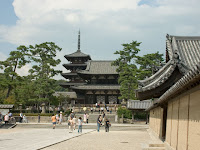
======
奈良時代710-794 Nara Period
The Period of Buddhism
-平城京Heijokyo capital at today’s Nara
-仏教の隆盛flourishing of Buddhism: the establishment of Buddhism as the state religion
*東大寺大仏 Daibutsu (Great Buddha statue at Todaiji temple) established by Emperor Shomu and a monk Gyoki
-文学Japan’s 3 oldest literatures
*日本書紀Nihon Shoki (“Chronicles of Japan”)
*古事記Kojiki (“Record of Ancient Matters”)
*万葉集Manyo Shu (“Anthology of 1,000 leafs” *poetic anthology)
<--use of 漢字kanji and 万葉仮名manyo gana:
Development of Japan’s native writing system
Daibutsu (big Buddha statue) in Todaiji temple

=====
平安時代794-1185 Heian Period
The Beginning of Kyoto as Capital City
-平安京Heiankyo in today’s Kyoto
-武家政治 (Samurai emerged as the guard against bandits →) first Samurai domination of Japan by 平家Heike Clan・平清盛Taira no Kiyomori
-ひらがな、カタカナdevelopment of hiragana, katakana
-女流作家flourishing female writers
*紫式部Murasaki Shikibu「源氏物語」 “Tales of Genji” (*Story)
*清少納言Seisho Nagon「枕草子」 “Pillow Book” (*essay)
-菅原道真Sugawara no Mitizane: Scholar: God of studying and school entrance exam
-空海(弘法大師)Kukai (Kobo Daishi): Monk: The most famous Calligrapher (one of the “Three Brushes”)
<calligraphy: “Shodo (way of writing)” or “Shuji (learning characters)”>
*Three Brushes: Kukai (Kobo Daishi), Emperor Saga, Tachibana no Hayanari
*Three major writing styles: Kaisho (Block style, standard script), Gyosho (semi-cursive style, running script), Sosho (cursive style, grass sccript)
Taira no Kiyomori

Murasaki Shikibu

Seisho Nagon

Kukai (Kobo Daishi)

=====
鎌倉時代1185-1333 Kamakura Period
The Period of the Rise of Samurai’s Power
-“Kamakura” is name of capital city (Kanto region)
-鎌倉幕府Kamakura Shogunate: Samurai government
*“Shogunate” means the government by Shogun (=military general)
*源氏Genji Clan: defeat Heike Clan
*源頼朝Minamoto no Yoritomo: Shogun, leader of Genji clan
*源義経 Minamoto no Yoshitsune:
Yoritomo’s brother in law, played a big role in the battles against
Heike Clan
→Genghis Khan?
*武蔵坊弁慶Musashibo Benkei: monk, Yoshitsune’s follower
----------------------------------------------------------------
-北条家 Hojo family succeeded the power after Yoritomo’s death.
*北条政子Hojo Masako (Minamoto no Yoritomo’s wife)
-元寇Mongolian Invasions on Kyushu by Khubilai Khan * “kamikaze”
Minamoto no Yoritomo

Minamoto no Yoshitsune

Musashibo benkei

Yoshitsune and Benkei

Hojo Masako

Genghis Khan and Khubilai Khan


=====
室町時代1333-1568 Muromachi Period
The Period of Disorder
-“Muromachi” is name of capital city (Kyoto in Kinki region)
-南北朝時代Northern and Southern Courts period 1336-1392
*南朝 South Imperial Court in Nara:後醍醐天皇Emperor Godaigo
*北朝 North Imperial Court in Kyoto:Ashikaga Takauji<--
Samurai(室町幕府Muromachi Shogunate)
→ 北朝Samurai = Muromachi Shogunate win
----------------------------------------------------------------
-応仁の乱 Onin War: over the successor of Shogun (son vs brother) 11 years
→ son won: the son is physically weak → Shogun’s power declined → 戦国時代warring states period
-禅宗の隆盛Zen Buddhism prospers.
-キリスト教伝来1549 Francisco de Xavier, from Spain, arrived at Kyushu region to preach Christianity.
Emperor Godaigo

Ashikaga Takauji

Francisco de Xavier

For this test, you need to study with the following two things:
1. Calligraphy video transcript
2. My post on the blog about the early history of Japan.
Also, this day is due of the first comparison paper (*see syllabus).
Here are the notes from today's class. Sorry if it looks messy.
===============================================================
縄文時代1,000BC-300BC Jomon Period
The Oldest Period
-縄文土器Cord-marked (=”Jomon”) pottery vessels
-竪穴式住居Pit houses
-狩猟採集生活Hunting and gathering → 稲作の始まりWet-rice cultivation begins
-土偶”Dogu” Clay Jomon figurines (only female figures)
Cord-marked (=”Jomon”) pottery vessels


Pit houses

Clay Jomon figurines (Dogu)

======================
弥生時代300BC-AD300 Yayoi Period
The Beginning of Rice Cultivation
-弥生土器 Yayoi pottery (* “Yayoi” is name of the place where the pottery was discovered.)
-竪穴式住居Pit houses
-稲作の広がりWet-rice cultivation spread all over Japan (except Hokkaido and Okinawa)
→ wealth and poverty, formation of clans, fight against each other
-Yamatai koku: Queen Himiko (in Kyushu region or Kinki region):中国との交流開始 International relations/trade with China starts
-銅器、鉄器の始まりfirst use of bronze and iron-edged tools (for agriculture and battle)
-「倭国」country name:“Wa”
Yayoi Pottery

====================
古墳時代300-710 Kofun Period
The Period of Tumulus, The Beginning of State
-大規模な古墳 Kofun (=ancient tomb)
*墳丘墓Mounded Tombs
*前方後円墳Front-squared and rear round tomb mound
*埴輪haniwa (sculptures to protect and/or house the spirit of the deceased)
-ヤマト王権Formation of the State: the first state in Japan, “Yamato” emerged.
Front-squared and rear round tomb mound

Haniwa


====================
飛鳥時代593-710 Asuka Period
The Period of Prince Shotoku, The Beginning of “Nihon”
-“Asuka” is the name of the capital city (Today’s Nara)
-推古天皇Empress Suiko
-聖徳太子Prince Shotoku 摂政regent to Suiko
← *Christ-like legendary figure
*十七条憲法seventeen-article constitution
*冠位十二階twelve court ranks
http://ha7.seikyou.ne.jp/home/wa-mi/naizou/icon/okanmuri.htm
*Prince Shotoku constructed Horyu-ji temple: the oldest wooden building in the world
*Interaction with China: Kenzuishi (Embassies to China)
仏教伝来introducing Buddhism to Japan from China
漢字伝来introducing Chinese characters kanji
------------------------------------------------------
After Empress Suiko and Prince Shotoku died, Soga Clan got control of politics.
→大化の改新604 Taika Reform (or Great Reform): the oldest coup
Prince Nakano Oe (later Emperor Tenji) killed Soga leader:
centralization of power to the emperor
-Name of the country: 倭Wa →日本 Nihon “Origin of Sun”
Prince Shotoku (on 1000 yen bill)

Horyuji temple

======
奈良時代710-794 Nara Period
The Period of Buddhism
-平城京Heijokyo capital at today’s Nara
-仏教の隆盛flourishing of Buddhism: the establishment of Buddhism as the state religion
*東大寺大仏 Daibutsu (Great Buddha statue at Todaiji temple) established by Emperor Shomu and a monk Gyoki
-文学Japan’s 3 oldest literatures
*日本書紀Nihon Shoki (“Chronicles of Japan”)
*古事記Kojiki (“Record of Ancient Matters”)
*万葉集Manyo Shu (“Anthology of 1,000 leafs” *poetic anthology)
<--use of 漢字kanji and 万葉仮名manyo gana:
Development of Japan’s native writing system
Daibutsu (big Buddha statue) in Todaiji temple

=====
平安時代794-1185 Heian Period
The Beginning of Kyoto as Capital City
-平安京Heiankyo in today’s Kyoto
-武家政治 (Samurai emerged as the guard against bandits →) first Samurai domination of Japan by 平家Heike Clan・平清盛Taira no Kiyomori
-ひらがな、カタカナdevelopment of hiragana, katakana
-女流作家flourishing female writers
*紫式部Murasaki Shikibu「源氏物語」 “Tales of Genji” (*Story)
*清少納言Seisho Nagon「枕草子」 “Pillow Book” (*essay)
-菅原道真Sugawara no Mitizane: Scholar: God of studying and school entrance exam
-空海(弘法大師)Kukai (Kobo Daishi): Monk: The most famous Calligrapher (one of the “Three Brushes”)
<calligraphy: “Shodo (way of writing)” or “Shuji (learning characters)”>
*Three Brushes: Kukai (Kobo Daishi), Emperor Saga, Tachibana no Hayanari
*Three major writing styles: Kaisho (Block style, standard script), Gyosho (semi-cursive style, running script), Sosho (cursive style, grass sccript)
Taira no Kiyomori

Murasaki Shikibu

Seisho Nagon

Kukai (Kobo Daishi)

=====
鎌倉時代1185-1333 Kamakura Period
The Period of the Rise of Samurai’s Power
-“Kamakura” is name of capital city (Kanto region)
-鎌倉幕府Kamakura Shogunate: Samurai government
*“Shogunate” means the government by Shogun (=military general)
*源氏Genji Clan: defeat Heike Clan
*源頼朝Minamoto no Yoritomo: Shogun, leader of Genji clan
*源義経 Minamoto no Yoshitsune:
Yoritomo’s brother in law, played a big role in the battles against
Heike Clan
→Genghis Khan?
*武蔵坊弁慶Musashibo Benkei: monk, Yoshitsune’s follower
----------------------------------------------------------------
-北条家 Hojo family succeeded the power after Yoritomo’s death.
*北条政子Hojo Masako (Minamoto no Yoritomo’s wife)
-元寇Mongolian Invasions on Kyushu by Khubilai Khan * “kamikaze”
Minamoto no Yoritomo

Minamoto no Yoshitsune

Musashibo benkei

Yoshitsune and Benkei

Hojo Masako

Genghis Khan and Khubilai Khan


=====
室町時代1333-1568 Muromachi Period
The Period of Disorder
-“Muromachi” is name of capital city (Kyoto in Kinki region)
-南北朝時代Northern and Southern Courts period 1336-1392
*南朝 South Imperial Court in Nara:後醍醐天皇Emperor Godaigo
*北朝 North Imperial Court in Kyoto:Ashikaga Takauji<--
Samurai(室町幕府Muromachi Shogunate)
→ 北朝Samurai = Muromachi Shogunate win
----------------------------------------------------------------
-応仁の乱 Onin War: over the successor of Shogun (son vs brother) 11 years
→ son won: the son is physically weak → Shogun’s power declined → 戦国時代warring states period
-禅宗の隆盛Zen Buddhism prospers.
-キリスト教伝来1549 Francisco de Xavier, from Spain, arrived at Kyushu region to preach Christianity.
Emperor Godaigo

Ashikaga Takauji

Francisco de Xavier

Subscribe to:
Posts (Atom)